Follow Us

quran recitation arabic with Tajweed 2025
Quran recitation Arabic is a sacred practice that resonates deeply when approached with reverence and precision. At Bayana Quran, we aim to guide believers in perfecting their recitation—honoring the original Arabic, observing the rules of tajweed, and understanding the rhythmic flow of the verses.
Whether you are new to the art of recitation or seeking to deepen your connection with the words of Allah, Bayana Quran offers a nurturing environment to grow spiritually and linguistically.
Basic Rules of Quran Recitation
Whether you are a beginner or an experienced reader, mastering arabic quran recitation requires starting with the fundamentals to ensure the words of Allah are treated with respect and precision. This involves not only reading smoothly but also maintaining the meaning and fluency of the Quranic text.
Proper Pronunciation and Modulation
A crucial step in learning to recite Quran in Arabic is mastering correct pronunciation. Even small mistakes can alter the meaning of a verse significantly. The rhythm and intonation of recitation are also important for delivering a spiritually enriching and accurate reading.
Introduction to Tajweed
At the core of quran tajweed recitation is the science of improving and perfecting Quranic recitation. Tajweed rules govern vowel lengths, articulation points, and other nuances that help ensure the Quran is recited exactly as it was revealed. Applying Tajweed protects the meaning and enhances the beauty of the recitation.
Understanding Arabic Letters and Points of Articulation
Arabic has unique sounds not present in many other languages. To achieve a complete Quran recitation, one must know not only the Arabic alphabet but also the specific articulation points (makharij) of each letter. This knowledge is essential for accurate and proper recitation.
The Importance of Tajweed Rules
Tajweed is essential for anyone who wants to produce the best recitation of the Holy Quran. Following these rules shows reverence for Allah’s words and prevents mistakes that could change the meaning. Moreover, Tajweed gives the recitation a rhythmic and melodious quality, increasing both spiritual connection and listener engagement.
Start Your Quranic Journey with Bayana Quran
Strengthen your connection with the Holy Quran and gain a deeper understanding of Islamic teachings through Bayana Quran. Our program offers access to expert instructors, interactive online classes, and a structured curriculum—designed to support comfortable, self-paced learning grounded in authentic Islamic knowledge.
Embark on your spiritual journey with Bayana Quran today and walk the path of personal growth, stronger faith, and lifelong learning—enriching your life in this world and the Hereafter.

Styles of Quran Recitation
Qirāʾāt (قراءات), the plural of Qirāʾah (قراءة), refers to the diverse styles of reciting the Holy Quran in Arabic. These styles encompass variations in pronunciation, phonetics, morphology, syntax, and sometimes vocabulary, all permissible within the framework of classical Arabic grammar and the rules of Tajweed. Each Qirāʾah is associated with a specific chain of transmission (Isnād) leading back to the Prophet Muhammad ﷺ, ensuring the preservation and authenticity of the Quranic text.
The term “Qirāʾah” is derived from the Arabic root “qaraʾa” (قرأ), meaning “to read” or “to recite.” In the context of Quranic studies, Qirāʾāt denotes the various accepted methods of reciting the Quranic verses. These methods were revealed to the Prophet ﷺ to accommodate the linguistic diversity of the Arab tribes, facilitating the memorization and recitation of the Quran across different dialects.
The science of Qirāʾāt plays a crucial role in the field of quran recitation arabic, as it preserves the linguistic richness and depth of the Quranic revelation. Understanding and mastering these styles not only enhances the beauty of recitation but also deepens the connection between the reciter and the divine message.
Does Qiraat or Different Recitation Contradict Quran Preservation?
The existence of multiple Qirāʾāt (recitation styles) does not contradict the preservation of the Quran. Instead, it exemplifies the Quran’s remarkable preservation. These variations are not different versions of the Quran but are minor differences in pronunciation, intonation, and sometimes word choice, all of which trace back to the Prophet Muhammad ﷺ. Each Qirāʾah adheres to the same Uthmanic script and conveys the same core message.
The Quran was revealed in seven Aḥruf (modes) to accommodate the linguistic diversity of the Arab tribes. Over time, these modes were preserved as distinct Qirāʾāt, each transmitted through an unbroken chain of narrators (Isnād). These chains ensure the authenticity and preservation of the Quranic text.
The differences among Qirāʾāt are minimal and do not alter the Quran’s message. For instance, variations like “Māliki” vs. “Maliki” in Surah Al-Fātiḥah (“Master of the Day of Judgment” vs. “King of the Day of Judgment”) reflect different pronunciations but convey complementary meanings. Such variations enrich the recitation without changing the underlying message.
Etiquettes and Manners of Quran Recitation
Quran recitation arabic is not merely about applying Tajweed rules and technical aspects; it is a profound act of worship that requires etiquette, humility, and respect. Observing proper manners during recitation allows the reader to honor the words of Allah and develop a deeper spiritual connection with the Quran.
Respectful Recitation
One of the essential etiquettes in quran recitation arabic is to read with ritual purity. This includes performing wudu (ablution) beforehand, ensuring both physical and spiritual cleanliness. Respect also means choosing a quiet, distraction-free environment to fully focus on the words, recognizing that every word recited is an act of worship deserving of sincere attention.
The Role of the Silence Symbol
During recitation, you might encounter the silence symbol (saktah), which signals the need to pause briefly without taking a breath. This pause is vital to preserve the correct meaning and natural rhythm of the verse. Attentiveness to such symbols reflects proper etiquette and respect for the divine message.
The Importance of Proper Etiquette
The Prophet Muhammad ﷺ emphasized reciting the Quran with humility, reflection, and sincere intention. Proper etiquette includes sitting respectfully, handling the Mushaf (the Quranic text) with care, and reciting slowly and gently. Etiquette goes beyond physical actions—it shapes the reader’s mindset and deepens the reverence for the Quran.
Creating an Ideal Environment for Recitation
To maximize the spiritual benefits of quran recitation arabic, creating a focused environment is key. Some simple ways to achieve this include:
- Finding a quiet place free from distractions.
- Sitting respectfully, ideally facing the Qiblah.
- Avoiding interruptions such as phones or irrelevant conversations.
- Reciting calmly and deliberately, taking time to reflect on the meanings.
By embracing these etiquettes and manners, the act of reciting the Quran becomes not just a routine but a beautiful expression of love and devotion. Respect, attentiveness, and sincerity transform quran recitation arabic into a heartfelt connection rather than a mere habitual reading.
Learn more: islamic quran
Refined Recitation Techniques in Quran Recitation Arabic
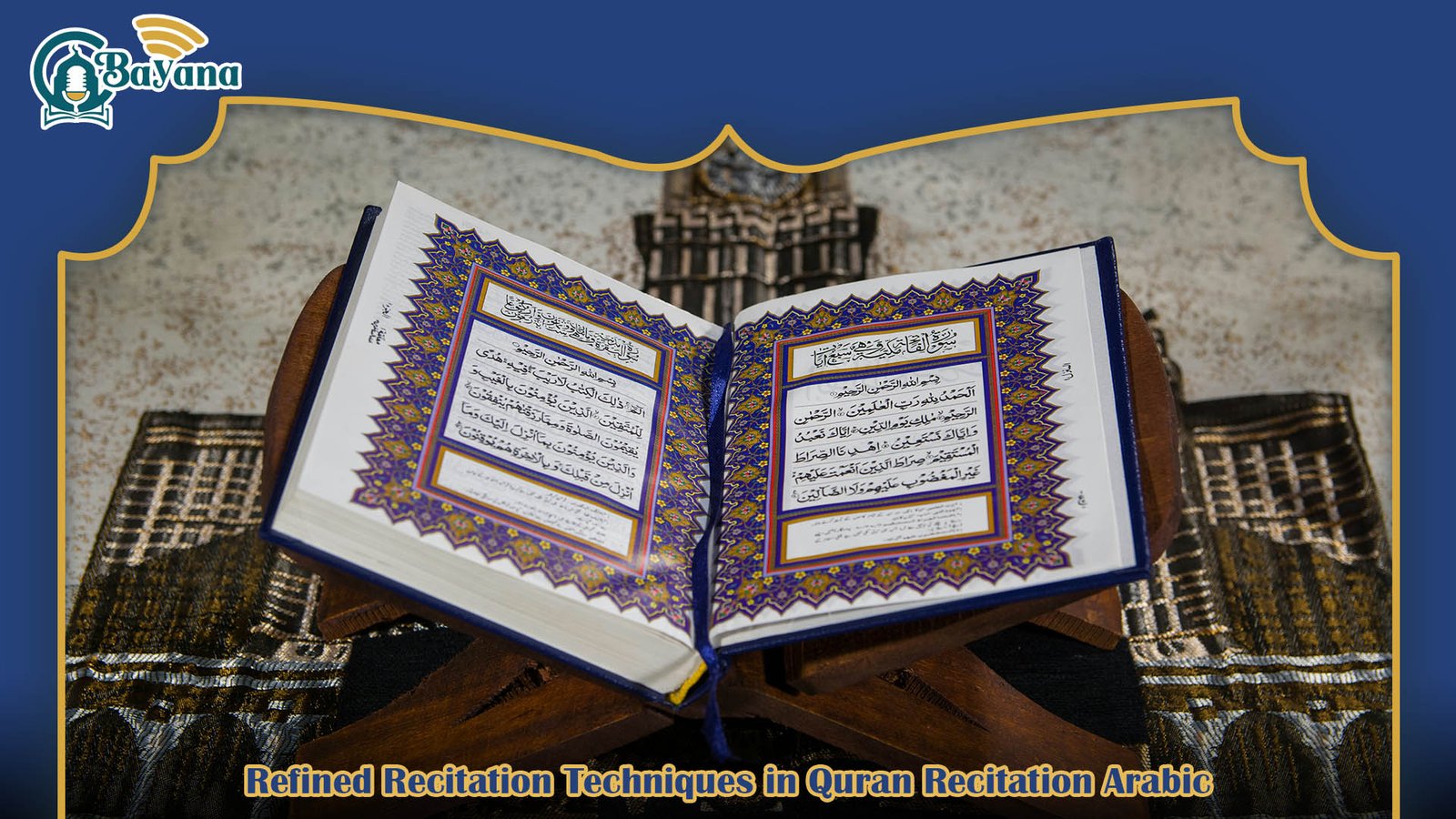
Mastering quran recitation arabic goes beyond applying Tajweed rules—it also involves developing rhythm, flow, and spiritual beauty in your voice. These recitation techniques not only enhance clarity and accuracy but also deepen your emotional and spiritual connection with the words of Allah.
1. Applying Madd (Elongation) for Melody and Smoothness
One of the essential techniques in quran recitation arabic is the proper use of Madd, or elongation. Reciters often use four-beat and six-beat Madds to bring smoothness and a melodic tone to the recitation.
Four-beat Madd provides a moderate elongation, creating a natural rhythm.
Six-beat Madd adds a dramatic emphasis, often used at the end of verses for spiritual impact.
When applied correctly, these techniques enhance the harmony of the recitation without compromising clarity.
2. Utilizing Qalqalah: Repetition for Clarity and Beauty
Another unique feature of quran recitation arabic is Qalqalah, the bouncing or echoing sound heard in specific letters (ق, ط, ب, ج, د) when they appear at the end of a word or are pronounced with Sukoon (silence).
Qalqalah improves pronunciation by avoiding the blending or loss of letters.
It adds a distinctive musical tone and clarity to recitation.
This technique helps maintain precision, ensuring that every letter is heard and pronounced correctly.
3. Developing Proper Recitation Habits
Fluent and beautiful quran recitation arabic is not achieved instantly. It requires consistent effort, sincerity, and proper guidance. Here are a few key steps:
- Daily Practice: Even a few verses a day will help build fluency over time.
- Slow and Correct Recitation: Focus on accuracy first; speed will come naturally.
- Imitate Skilled Reciters: Listen carefully and repeat after experienced Qaris to internalize proper rhythm and pitch.
- Learn with a Teacher: A qualified tutor will provide essential corrections and guide you in mastering tone, breath, and Tajweed rules.
4. Seeking Feedback to Eliminate Mistakes
One of the most important aspects of improving quran recitation arabic is identifying and correcting mistakes early. Pronunciation errors, especially in Tajweed or elongation, can unintentionally alter meanings.
- Record your recitation and review it for accuracy.
- Request feedback from a teacher or mentor regularly.
- Repetition and correction help build long-term, accurate habits.
- Frequently Asked Questions
To help deepen your understanding and improve your recitation, below are three common questions many learners have when studying Quran Recitation Arabic.
1. How important is Tajweed, and what are its basic rules?
Tajweed is essential for correct and beautiful recitation. It includes rules about pronunciation, articulation points (makhaarij), proper elongation (madd), correct pauses (waqf), and more.
2. Can non-native Arabic speakers achieve perfect recitation?
Yes, non-native speakers can achieve excellent recitation. With consistent practice, guidance from a qualified teacher, and attention to common mistakes—like mispronouncing letters or mixing sounds—anyone can improve significantly.
3. What are common mistakes to avoid in Quranic recitation Arabic?
Common mistakes include rushing through verses, incorrect articulation of letters, neglecting to observe rules of pause and stop, and failing to apply elongation properly. Recognizing and correcting these mistakes through tajweed knowledge is crucial.
In conclusion, Quran recitation Arabic is more than a ritual—it is a gateway to spiritual growth, inner peace, and deeper connection with the Divine. As many scholars underline, reciting the Quran in its original language preserves its authenticity, carries immense rewards for each letter pronounced, and brings tranquility to the heart, even in times of hardship.
Read more: free quran